
Several months ago, I started following the Walk for Peace. It was a group of about 20 Buddhist monks from Texas. They had received guidance, wisdom, or whatever you might call it, that they should be leaving the Monastery and walking out into the world to highlight the cause of peace. Not a protest, but a pilgrimage.
They were not looking necessarily to make a big splash in the world. They didn’t have some kind of big schedule. It was not a tour in the way we sometimes think about musical groups. No billboards. No advertisements. No merchandise for sale. Just some monks walking along the way day by day.
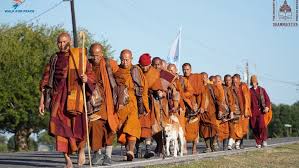
It was going to be a substantial journey—2,300 miles. They had chosen a route that would take them through places that had histories of conflict and violence. They intentionally chose to walk through the South with its history of racism and the Civil War and the Civil Rights Movement. They would encounter people protesting their Buddhist beliefs. They would have people tell them that they were going to hell. They would receive insults. It was going to be a long, hard, and challenging journey.
They would walk barefoot sometimes. They would walk in the rain. They would walk in the ice and snow. They would walk every day. They would eat one meal a day. They would maintain their spiritual practices along the way.
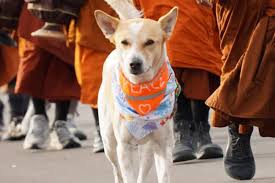
They walked with Aloka (the name means ‘Light’) the Peace Dog—who has his own amazing story. He was a stray in India when monks were walking there. He fell in with this group of monks and joined their journey. He’s just a mutt—no pedigree here—just a street dog who was getting by. The monks adopted Aloka, or perhaps Aloka adopted them. It’s hard to tell. Aloka also has a marking on his forehead that looks like a white heart. His quiet walking alongside the monks adds to the story.
Along the way something started to happen. People began to get word about the monks and their Walk for Peace. People started showing up just to see them walk. People gave them flowers. People bowed in respect. People began to follow along online.
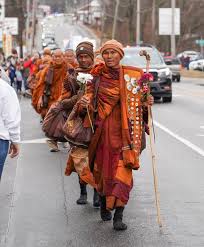
Police departments were showing up to offer escorts. Many of these departments also presented the monks with badges and pins. The further they went, the more ‘decorations’ they received. They were pinned to the stole worn by the Venerable Bhikkiu Pannakara.
News outlets started to cover their walk. People around the country became intrigued by these monks and their journey. Photographers were taking their pictures and making videos. Artists were inspired to draw and paint to capture the spirit of the walk. Social media became filled with images of the Venerable Monks. Their quiet walk had grown in volume!
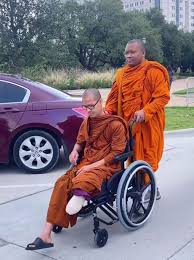
There were incredible challenges along the way. In Houston a vehicle had plowed into one of the escort vehicles which then struck the monks. One monk was seriously injured. He endured several surgeries before the decision was made that his leg would be amputated. He had began the Walk for Peace hoping to walk into DC months later; he found himself unable to walk at all. He was not bitter or seeking retribution for the accident or his condition. Truly his inner peace was revealed for all to see. He was able to join his brothers later in the journey now in a wheelchair.
Aloka, too, needed veterinary care along the journey. Anyone with any sense of compassion will do everything possible to take care of a hurt animal. Aloka was treated and recovered. His pace was more regulated going forward. He sometimes rode in the support van for good portions of the trip, but he preferred to walk.
The Veneable Bhikkiu Pannakara, the leader of the Venerable Monks, also had an episode that required medical attention and recovery. It’s hard to walk an average of 20 or more miles per day without experiencing some strains on the body and mind. Some hardship was to be expected, but the Venerable Monks pressed on.
As they were making their way through the Carolinas I was hoping to get a chance to participate. I was drawn to their discipline. I was fascinated by their persistence. I was struck by the manner in which they carried themselves. I wanted to walk at least a couple miles of this journey with them to show support and solidarity. But the circumstances were not presenting themselves. I could watch from afar like so many others and find inspiration.
By the time the journey was ending the Venerable Monks were greeted by huge crowds of people. The ceremony at the Lincoln Memorial was impressive. There was an interfaith gathering at the National Cathedral. People had gotten the word and the message that ‘Today is going to be my peaceful day.’
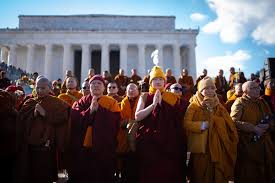
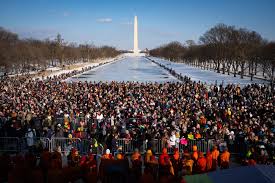
I was able to tune in online for a service the Venerable Monks led at George Mason University. I was so glad to be able to sit and meditate with the monks and those who had gathered. A large crowd of people sitting in silence and finding some sense of the inner peace that the Venerable Monks had carried with them through the days and miles. Like lots of others this would be the culmination of the Walk for Peace for me.
The next day the Veneable Monks would board a bus that would take them back to their monastery in Texas.
There’s an old saying, ‘if you sit still long enough, the world will come to you.’
I got up on Friday morning and discovered through social media that the Walk for Peace would be making a lunch stop in Morristown, Tennessee—only about 30 minutes from our cottage. It was a beautiful, sunny day. I changed my plans to drive up and listen and take part in the Walk for Peace.
I stood on the lawn of the venue for a good while. I talked with other folks who had been drawn to this journey. Made a new friend, and we talked a good bit about life and journeys and how to enjoy this part of the world.
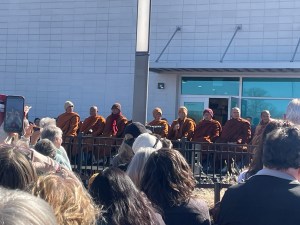
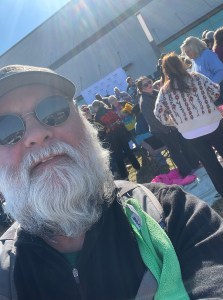
I got to hear Venerable Bhikkiu Pannakara speak about their journey. He hadn’t envisioned that we was going to talking along the way. But now he was talking several times a day to sometimes thousands of people. He was talking about mindfulness and being at peace within ourselves. He was thanking people who had made the journey possible and blessed them along the way. He was teaching about how the monks approach their own practice of mindfulness and peaceful compassion. He told us that since Buddhists believe in reincarnation that it’s possible Aloka was a monk in a former life. The crowd listened and learned and, I’m sure like me, loved the chance to be part of this movement in this small way.
At the end of the gathering they handed out ‘peace cords’ which they had given along the way. I had seen videos of them tying peace cords on the wrists of those who were physically and mentally challenged. It was simple gift, a gracious gesture, and a fitting remembrance. Just a few strands of yarn woven together.
In a world that is filled with all manner of vice, vitriol, and violence, the Walk for Peace was good news—something positive, something light. Venerable Monks and their faithful dog, Aloka, were doing nothing more than walking a journey with a message for peace. One step after another, one day after another, moving forward with peace in their hearts for all living beings. ‘May you and all living beings be well, happy, and at peace.’
I count myself fortunate to have had this experience. It was delightful to watch them progress and make an impact on their way. I am grateful that by sitting still their journey came close to me.
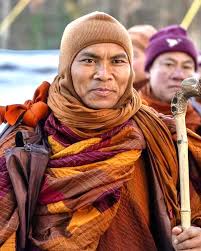

[I take no credit for the photos taken by others along the way. I include them simply so that you may gain a visual sense of the background to the story.]
 Character in the Making
I had hoped to be there when the monks passed through Pittsboro, NC. My sister lives near there. Th
LikeLike
This is a beautiful personal story and summary of the Walk for Peace, Les. I hope you will consider sharing it with their online community too. I am so grateful that they passed through close enough for you to reach all of them and Aloka! It is fitting for you as a Lay Cistercian to have been given this opportunity!
LikeLike
I, too, followed their journey every day online. So beautiful and inspiring. Glad you got to see them in person (I am a bit envious 😊). Thanks for sharing your thoughts.
LikeLike
So happy to read your account of this pilgrimage for peace. May you continue to see signs of hope as you sit, stand, and walk along your way.
LikeLiked by 2 people