
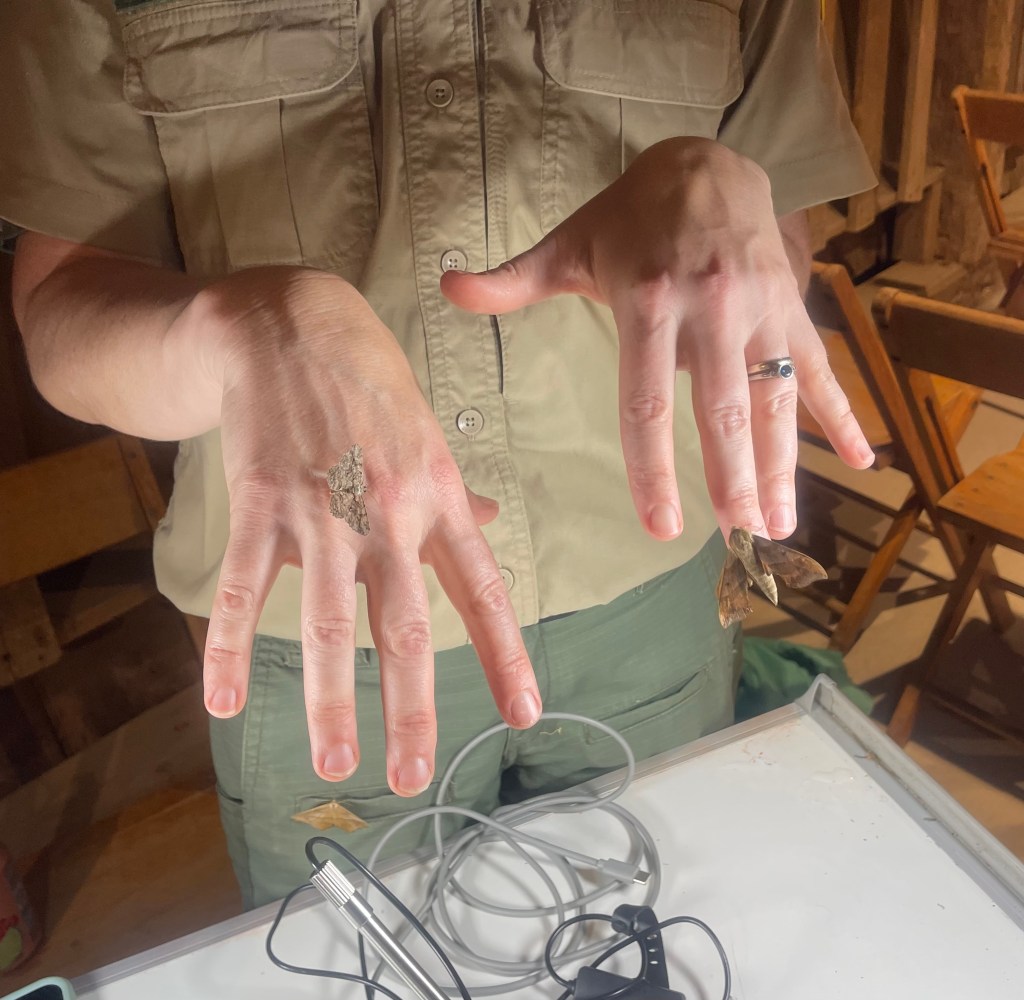
It’s National Moth Week, in case you didn’t know [nationalmothweek.org]. I didn’t. It’s another piece of information that has come my way recently since I’ve started the Tennessee Naturalist Program at the Seven Island State Birding Park chapter
The one piece of information that most folks know about moths is that they’re drawn to light. Not exactly earth-shattering intel right there. We’ve all sort of known that since we were children. We sat on the front porch and watched as moths circled the light with countless other bugs. The crickets were singing away and the evening seemed peaceful and serene.
We knew that there were different species of moths, but we didn’t think much past that. We would be excited to see a luna moth with its sizeable green wings. We casually dismissed others that were less spectacular. We could tell they were moths, but not much else.
We would use cedar chests to keep moths from eating our woolies. Both of those items have been going out of use for quite some time now.
Do you remember the smell of ‘moth balls’—little round spheres of smell that were intended to keep moths away from the clothes. Of course, then the clothes would smell like ‘moth balls’ which meant they might not get worn at all. No one wants to smell like repellant, right? I can still remember that one of the clergy at my ordination service had a robe on that hinted at that smell. Rarely used, I guess.
But I’m learning new things all the time.
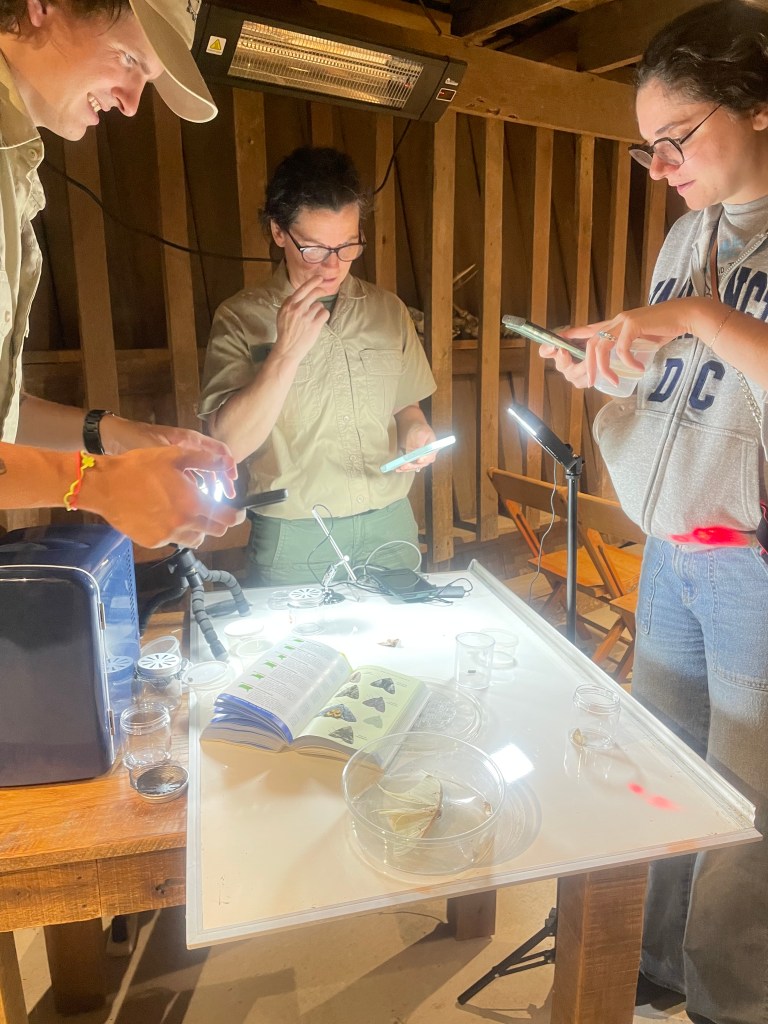
Last night several of us gathered at Seven Islands State Birding Park for a program entitled Creatures of the Night: Moths. Yes, it is in honor of National Moth Week.
We watched a program presented by Ranger Clare about the differences between moths and butterflies. While butterflies seem to get all the good press, moths are seriously under represented. In the state of Tennessee there are about 10 times more species of moths than of butterflies. We were reminded that typically butterflies perch with their wings upright, while most moths lay out flat. Male moths especially have fuzzy antennae that help them locate females for breeding. Adult moths are focused on breeding and it is the shortest life cycle stage for them. Moths are also one of the main food sources for birds, so let’s remember how important they are in the system that gives us indigo buntings and song sparrows and summer tanagers!
Then we got to the fun part. We took small jars and bug nets and headed out to locations where the park staff had put up sheets and blacklights that were attracting moths. It takes a little practice to catch a moth against the sheet and get a lid screwed on without losing the quarry. Some moths were too big to catch in a bottle, so the nets were useful as well. I had on ‘the shirt’ (different story) so I had room for about four bottles in my pockets. Out to the field to catch some and then bring them back to the Blue Bird Barn to be photographed and identified.
Ranger Clare has a small—and I mean really, really small, as in wouldn’t even hold a six-pack small—refrigerator. We would put the jars in there for a little bit. The cooler temps would make the moths settle down some from the experience of being caught and contained.
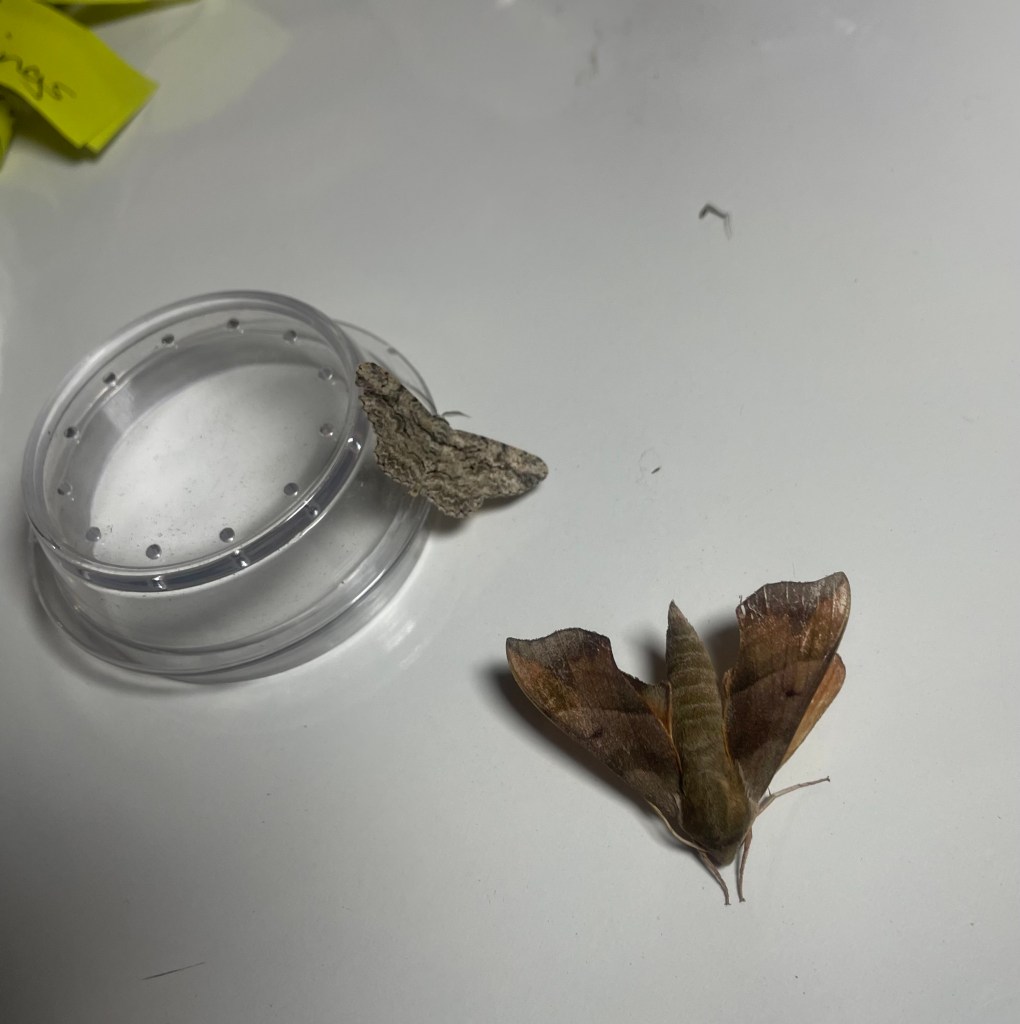
Then she would open the containers and take pictures of our moths. Different colors, different sizes, different activity levels. Some were quite content to just sit on the white board that she was using for a background. Others were quick to fly a bit and find another spot to light. But all of them were fascinating.
Ranger Clare had a special microscopic lense that connected to her phone so that we could see the intricacies in greater detail. The colors and patterns and finer points were magnified and magnificent.
It was fun to see the list grow as we returned from our pursuits. As the night went on we kept hearing, ‘Oh, now that’s the best find of the night!’ But it would be surpassed a bit later by another specimen that we hadn’t yet cataloged.
When we were actually taking down the screen/sheets at the end of the evening we saw a couple of Emperor Moths that were just stunning. And again, Clare declared that these were the best finds of the night. Hard to argue.
All of these examples were recorded and uploaded to iNaturalist which is compiling the lists from this week so that we can better understand these winged wonders. I think that we had seen about 30 diferent species through the few hours that we were researching. It was incredibly interesting and also delightful to participate.
So maybe you’ll have the time to sit on the porch this week and see something new. That little moth that is flitting around your front door is a marvelous creature!
[If you would like to learn more, iNaturalist is a free app that can help you identifiy moths and all kinds of other bugs, birds, plants, and animals. I encourage you to check it out and be part of this process.]


This is so neat!! Great post and great pictures. I’m inspired to get a portable black light source and magnifier. Please continue to blog your adventures, and often! 🦋🌛🤓
LikeLike